Native Grasses for Texas

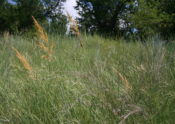
One may be surprised to learn that bermudagrass and bahiagrass are NOT native to Texas much less to the United States. There are numerous species of grasses and forbs that can be utilized for forage throughout the state of Texas. Keep in mind as we select forages we need to be mindful of our production system goals, location (soil type and rainfall), and the nutrient needs of our livestock (and/or wildlife). Many livestock producers are considering forage species and varieties that do not require as much fertilizer as… Read More →

Impact of Sub Freezing Temperatures on Warm-Season Perennial Grasses

Warm-season perennial grasses are the basis of pasture systems and livestock production in Texas. The most prominent warm season species are bermudagrass (seeded and hybrid) and bahiagrass. Neither of these species is native to the state of Texas but they are well adapted to Central and East Texas. Unfortunately they can be greatly impacted by cold winter temperatures. Central and East Texas have seen record temperatures in late December. Many may be concerned about whether or not their warm season forages have survived these weather conditions.   Bermudagrass… Read More →

Weed of the Week: Buttercup

Buttercup (Ranunculus species): One of the many yellow flowering weeds that we fight in pastures and hay meadows. Buttercup is a winter annual that thrives in weak or thin pastures. There are several species of this winter annual. They differ mainly in leaf shape and growth, but all produce characteristic bright yellow blossoms. March to early April is the best time to kill buttercup. The goal is to spray buttercup before bloom.   Fertilizing and liming to soil test recommendations and efficient utilization of pastures or hay fields are… Read More →

Establishing Bermudagrass

When it comes to establishing bermudagrass from sprigs there are several things to keep in mind before we start tilling the soil… Location: Choose a well drained soil; bermudagrass does not do well on wet-land (except for Jiggs Bermudagrass).   Variety Selection: Match variety to soil type, average rainfall, production goals, and willingness to manage (provide fertility, etc.). Find more information on bermudagrass varieties Bermudagrass Varieties, Hybrids, and Blends for Texas.   Weed Control: Destroy existing vegetation by spraying actively growing weeds with glyphosate. Ideal time to start… Read More →

Liquid Calcium: A substitute for what?

Liquid Calcium:  A substitute for what? The transportation and application costs associated with limestone applications often exceeds the cost of the limestone by 10-30 times.  When soil test recommendations call for three, four or even five tons per acre, the end cost can sometimes exceed $300 per acre.  Increasingly producers are looking toward non-traditional approaches to battle low soil pH.  Over the past several years, online ad posting have stressed the liquid calcium formulation marketed by company X or Y is many times more available than the calcium… Read More →

Poultry Litter

AgriLife Logo

Poultry litter has become a common alternative source of plant nutrients in Central and East Texas. Especially as the poultry industry grows in parts of Central and East Texas. Broiler litter is a mixture of poultry manure, bedding, feathers, and spilled feed. The actual nutrient content of a manure sample varies. Nutrient concentration of broiler litter is variable due to age of bird, composition of the diet, how the manure is handled, and the number of batches of birds raised since the last house clean out. The average… Read More →

Legumes Can Provide Nitrogen

Commercial fertilizers are the most costly input for  warm season grass forage production for hay and pastures. With high fertilizer prices there is increased  interest in utilizing legumes to offset the cost of nitrogen. Here are some facts that you need to keep in mind when deciding whether or not to introduce cool season legumes into your forage system: Clovers are cool season legumes with the ability to fix atmospheric nitrogen as a result of their symbiotic relationship with Rhizobium Specific Rhizobium inoculant is required for each clover… Read More →

Winter Pasture Program August 23rd

Reduce Winter Feeding with Stockpiled Forage and Winter Pasture   Friday, August 23, 2024 Texas A&M AgriLife Research and Extension Center 1710 N Hwy 3053, Overton, TX 75684   Reduce hay needs and winter-feeding expenses by using winter pastures. Topics Include: Stockpiled forage: management and utilization Cool-season forages and variety selection Acres needed per cow for stockpiled forage and winter pasture Establishment and fertilization Monthly and seasonal forage production potential Appropriate mineral supplementation Estimated costs   Register online at: http://agriliferegister.tamu.edu/ansc-ev-051 or go to agriliferegister.tamu.edu and search by location “Overton”… Read More →

Limestone: Who, What, When, Why & How

Who Needs Limestone: Many Texas soils are acid soils; that is, the soil pH is less than 7.0. Soil acidity is caused by various environmental, climatic, and cultural factors. The most common of these factors are: Parent material from which the soil is derived. Leaching by rainfall or irrigation that removes basic elements such as calcium, magnesium, and sodium from the soil profile leaving acidic hydrogen, aluminum, and manganese. Cultural practices such as nitrogen fertilization, removal of harvested crops and associated basic elements, and soil erosion, which results… Read More →

It’s Time to Get a Soil Sample Analyzed

Soil Test!  Soil Test!  Soil Test!  If you have not done so for this year, please consider obtaining a soil test now.  There is not much that can be done regarding the high cost of fertilizer, but there is much we can do regarding how efficiently we use fertilizer.  The soil test is the first step in efficient fertilizer use and improved forage production.  Samples should be collected annually for hay meadows and every 2 to 3 years for grazing pastures.  For soil forms and bags contact your… Read More →