Bermudagrass Stem Maggots, Fall Armyworms, and Grasshoppers. Oh my!

The bermudagrass stem maggot (Atherigona reversura), a pest of bermudagrass forage in Texas has been reported annually since 2012. The fly (yellow with black head) lays its eggs within the stem of the bermudagrass plant. Once the egg hatches the larva, or maggot, (white with black head, 1/8” – 3/16” long) moves to the last plant node and consumes the plant material within the stem. This stem damage results in the death of the top two to three leaves while the rest of the plant remains green. This… Read More →

Weed of the Week: Wild Carrot

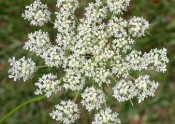
Wild Carrot (Daucus carota): Wild Carrot, also known as queen anne’s lace, is a biennial broadleaf plant. Wild carrot forms a rosette of leaves the first year, then flowers, produces seed, and dies the second year. It forms a deep, whitish taproot that has a distinctive carrot odor. Mature plants reach 2 to 4 feet tall and have erect stems and few branches. Leaves divide several times, forming many long, narrow segments. Leaves on the lower part of the plant have stalks. Those on the upper part of… Read More →

Rained on Hay

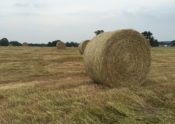
After mowing, poor weather and handling conditions can lower hay quality. Rain can cause leaf loss and can leach nutrients from plants during curing. Rain can leach out nutrients and increase dry matter loss from respiration, which is the process by which a plant uses oxygen. Nutrient losses depend on the amount, duration and timing of the rain in relation to cutting time. Purdue University has conducted research on the amount of total digestible nutrients (TDN) and field dry matter lost from hay after a rain. The study… Read More →

Weed of the Week: Horseweed

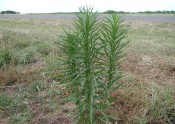
Young Horseweed

Horseweed (Conyza canadensis): Often times called: mare’s tail. Warm season erect annual weed. Often found in cultivated areas, pastures, road sides and waste sites. First leaves are in a rosette. Stem with frequent alternate and sessile leaves. Horseweed generally bolts in April/May, flowers in July and sets and disperse seed from August to October. Control of horseweed is more effective when plants are in the rosette stage or less than 2 inches tall.             Select Herbicide Options: Weedmaster 2, 4-D GrazonNext HL Duracor… Read More →

Blackberries and Dewberries

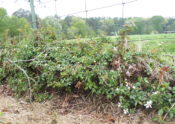
Blackberry and dewberry are closely related, but they are very different in growth habits and physical characteristics. Dewberry exhibits a low, vine-like, trailing growth habit that forms mats that are rarely taller than 2 feet above the ground. Blackberry typically has an upright rambling growth habit, which can form impenetrable thickets that are often 4 to 6 feet tall. Stems of dewberry have slender thorns and numerous red hairs, while upright blackberry stems have few to no hairs and numerous hard, broad-based thorns. Dewberry also tend to flower about… Read More →

Weed of the Week: Yellow False Indigo

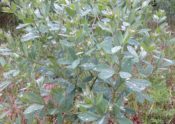
Yellow False Indigo (Baptisia sphaerocarpa) have a very wide, natural range to which they seem well adapted. It is native to the lower Midwest and Gulf states. As a group, these perennials are deer resistant, heat and humidity tolerant and drought tolerant. Height and width vary by species. It grow up to 2 to 3 feet tall by 2 to 4 feet wide with upright stems. Flower spikes are 12 to 15 inches long with large, bright yellow flowers held above bright green foliage. Most indigo species bloom… Read More →

Liquid Lime

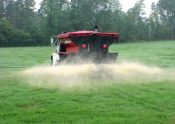
Lime is often recommended for pastures and hay meadows in order to increase soil pH. Many forages can be sensitive to soil pH, especially acidic soils (soil pH < 7). Maintaining an appropriate soil pH can increase nutrient use efficiency, meaning plant roots have the capability to pull nutrients from the soil and use them for plant growth and persistence. Liquid lime is a formulation of approximately 50% high quality dry lime and 50% water. Some advantages of liquid lime include: providing better uniformity of spread and reacting… Read More →

East Texas Pasture Management February 18th

AgriLife Logo

East Texas Pasture Management Program Virtual February 18, 2022 5 CEUs available (3 general, 1 IPM & 1 Laws & Regulations) The event program will cover the following topics: impact of grazing management on weed production alternative nutrient sources for bermudagrass pesticide safety weed control strategies for pastures and hay fields laws and regulations of pesticide use   Register online at: https://agriliferegister.tamu.edu/Overton For more details see the FLYER.     Vanessa Corriher-Olson Forage Extension Specialist Soil & Crop Sciences Overton, TX vacorriher@ag.tamu.edu Texas A&M AgriLife Extension Service Texas A&M… Read More →

Ranchers Leasing Workshop

AgriLife Logo

Leasing property is very common in Texas. Whether you are leasing property for grazing, hunting and/or livestock. If you are looking for more information on leasing property in Texas make sure you attend the… Ranchers Leasing Workshop Hallsville, TX January 10, 2022 Noon- 4:00 pm Registration $50.00 (lunch included) Register online @ https://agriliferegister.tamu.edu/aglaw FLYER     Dr. Vanessa Corriher-Olson, Ph.D. Forage Extension Specialist Texas A&M AgriLife Extension Soil & Crop Sciences Department Overton, TX vacorriher@ag.tamu.edu

Bastard Cabbage – A Widespread Noxious Cool-Season Annual Weed

Bastard cabbage (Rapistrum rugosum) is a cool-season annual, multi-branched, herbaceous plant native to Eurasia that grows from one to five feet or more in height.  It has a robust taproot and dark green leaves that are lobed and wrinkled, but sometimes have a reddish cast.  Bastard cabbage typically flowers from early spring into summer, bearing clusters of small, showy yellow flowers at the tips of its branches.  Bastard cabbage can be identified by its unusually shaped two-segmented seed capsule.  The seed capsule is stalked, with a long beak… Read More →